los switches operan en capa 2 payload maximo permitido es 1500bytes
ethernet opera en capa fisica y data link. en data link se encuentan 2 subcapas(sublayers):
- LLC -> se comunica con las capas superiores (IPv4 o IPv6 por ejemplo) y con el hardware en las capas inferiores.
- MAC ->
- data encapsulation:
- ethernet frame
- ethernet addressing (source and destination MAC addresses)
- ethernet error detection with frame check secuence (FCS trailer)
- accessing the media: incluye las especificaciones para diferentes estandares de comunicacion ethernet a traves de distintos tipos de medios fisicos. Hoy en dia ethernet operan en full-duplex pero Ethernet en half-duplex usa CSMA-CD.
- data encapsulation:
local area networks (LAN)
- estan separadas por routers, no switches
- es una red contenida en un area pequena como un piso de oficina
- se usan routers para conectar distintas LANs
ethernet frame(capa 2)
el tamano minimo de un frame son 64 bytes y el maximo son 1518 bytes
- 64 bytes - 18 bytes (header + trailer size) = 46 bytes
- entonces el tamano minimo de un payload son 46 bytes
- en caso de que el payload sea menor a 46 bytes, se agregan bytes de padding un frame ethernet mayor a 1500 bytes es consierado un jumbo frame
partes que lo componen:
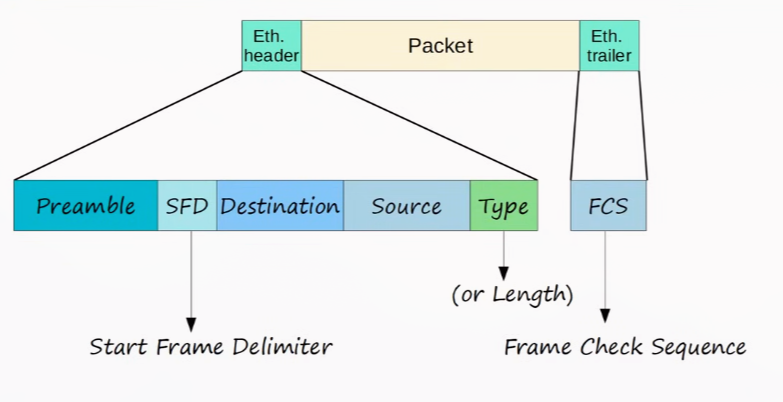 el preamble y SFD no se consideran parte del header
preamble:
el preamble y SFD no se consideran parte del header
preamble:
- 7 bytes (56 bits)
- alterna 1’s y 0’s
- 10101010 * 7
- permite a los dispositivos sincronizar sus clocks SFD (start frame delimiter):
- 1 byte (8 bits)
- 10101011
- marca el final del preamble y el comienzo del resto del frame
campos del header: destination y source:
- indica los dispositivos enviando y recibiendo el frame
- consisten del ‘MAC address’ del emisor y del receptor
- MAC = media access control
- 6 byte (48-bit) tamano de la direccion del dispositivo fisico
type:
- 2 byte/16-bit
- si su valor es >=1536(0x0600) se interpreta como type, sino se interpreta como length
- dice que protocolo viaja dentro (IPv4, IPv6, ARP)
- 0x0800 IPv4
- 0x86DD IPv6 length:
- si su valor es <=1500 se interpreta como length, sino se interpreta como type
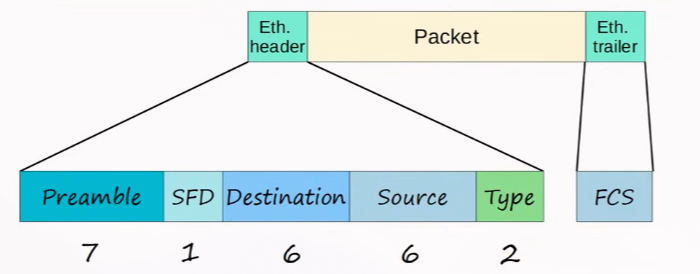
campo del trailer: FCS (frame check sequence):
- 4 bytes (32 bits) de largo
- detecta datos corrompidos al correr un algoritmo “CRC” a los datos recibidos
- CRC = ‘cyclic redundancy check’
= 26 bytes (header + trailer)
direcciones MAC
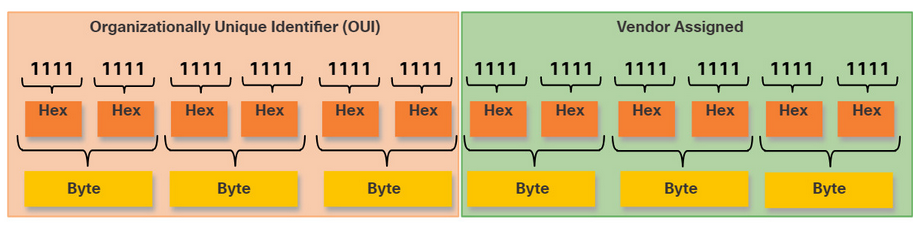
- 6 bytes(48-bits) direccion fisica asignada al dispositivo cuando se lo fabrica
- ‘burned-in address’ (BIA)
- es globalmente unica
- los primeros 3 bytes son el OUI (organizationally unique identifier), el cual es asignado a la compania creando el dispositivo
- los ultimos 3 bytes son unicos al dispositivo en si mismo
- se escribe como 12 caracteres hexadecimales
- cada switch tiene una tabla de direcciones MAC
- si el switch no conoce la direccion de un frame ethernet hace un FLOOD de este en todas sus interfaces, menos en la que recibio el frame
- si el switch no conoce la direccion de un frame ethernet hace un FLOOD de este en todas sus interfaces, menos en la que recibio el frame
direcciones aprendidas dinamicamente
se aprenden automaticamente por switches desde el trafico de la red (con CCNA/notes/resources/ARP)
- son removidas de la tabla luego de 5 min de inactividad en switches Cisco
direcciones aprendidas estaticamente
son configuradas manualmente para dispositivos especificos, estas proveen mayor seguridad o control dado que nunca expiran y tienen mayor prioridad
dentro de un paquete IP se encuentran los campos:
- src IP: 192.168.1.1
- dst IP: 192.168.1.3
- src MAC: .9D00 por ejemplo.
- dst MAC: ??? para conocer la direccion MAC del destinatario se utilizan paquetes del tipo CCNA/notes/resources/ARP y en IPv6 neighbor discovery se envia con una direccion de destination = FFFF.FFFF.FFFF que es la direccion broadcast en MAC
para verificar si dos dispositivos se pueden conectar entre si se usa ping
tipo de trafico con direcciones MAC
- unicast: un frame es enviado por un unico dispositivo transmisor a un unico dispositivo. Para conocer direcciones de destino MAC es usado: IPv4 -> ARP; IPv6 neighbor discovery.
- broadcast: un frame es recibido y procesado por todos los dispositivos en la LAN ethernet:
- direccion MAC FF-FF-FF-FF-FF-FF
- flood en todos los puertos de switches ethernet excepto por el que recibe
- routers no hacen forwarding de estos frames
- si los datos encapsulados fuera un paquete IPv4, la direccion de destino del paquete sera 1.1.1.1. no siempre se envia un paquete IPv4 en un ethernet broadcast. En IPv6 utiliza multicast como si fuera broadcast.
multicast
este frame es recibido y procesado por un grupo de dispositivos en la LAN ethernet que pertenecen al mismo grupo multicast - destino MAC 01-00-5E cuando los datos encapsulados son un paquete IPv4 multicast - destino MAC 33-33 cuando los datos encapsulados son un paquete IPv6 multicast - tambien hay otras direcciones MAC multicast reservadas para cuando los datos no son IP, como para STP y LLDP - si un switch no esta configurado para multicast snooping, flood en todos los puertos del switch, excepto por el que recibe si los datos encapsulados son un paquete IP multicast, los dispositivos pertenecientes al grupo seran asignados direcciones IPv4 desde 224.0.0.0 a 239.257.257.257. El rango en direcciones IPv6 comienza por ff00::/8
la direccion MAC multicast se calcula a partir de los campos de direccion IP de destino
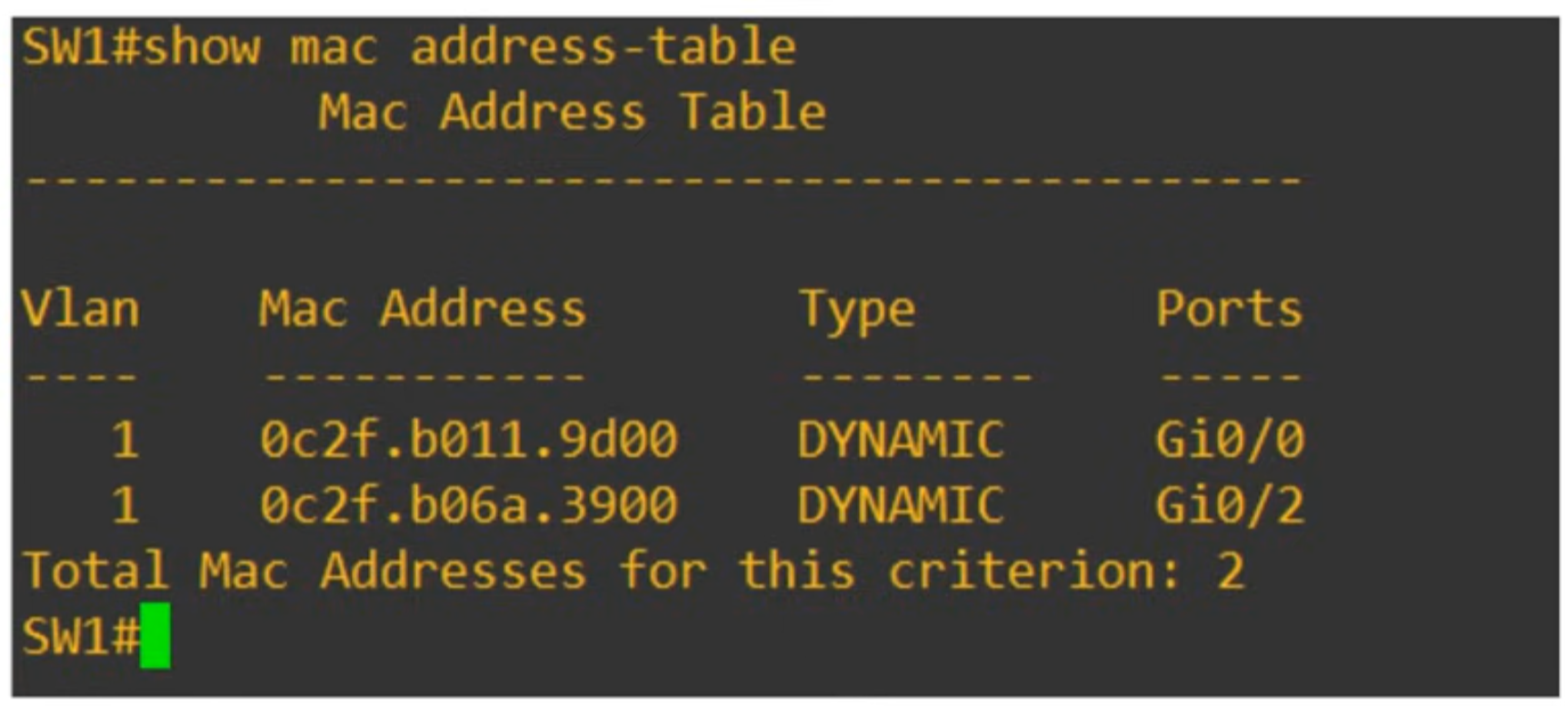
MAC address table
tambien conocida como content addressable memory (CAM) table. MAC address table es donde un switch examina para decidir por donde reenviar frames
MAC learning cada frame que entra al switch es analizado en busqueda de direccion MAC de origen y asociandolo a su numero de puerto del switch correspondiente.
- Si la direccion de origen MAC no esta registrada en la tabla, se anade junto al numero de puerto del switch.
- En caso de que la direccion MAC de origen si exista, el switch actualiza el timer para esa entrada (por default las entradas en la tabla duran 5 minutos)
- si ya existe la entrada para esa direccion MAC pero por un puerto distinto, se actualizara el timer y el numero de puerto al mas actualizado
frame forwarding si el switch recibe un frame unicast y hay un match en la direccion MAC de destino del frame y una entrada en el address table se reenviara en frame en el puerto especificado. Si la direccion MAC de destino no esta en la tabla se hara flood del frame por todos los puertos excepto por el que lo recibio
es decir:
- si la direccion MAC destino del frame esta en la tabla y el puerto asociado es distinto al que recibe el frame -> la reenvia solo al puerto asociado a esa direccion
- si la direccion MAC destino del frame esta asociada al mismo puerto que recibe el frame -> se descarta el frame porque son parte del mismo “cable”
- si la direccion MAC destino no esta en la tabla se hace flood por todos los puertos menos por el que lo recibe
en Cisco IOS: show mac address-table
borrar direcciones dinamicas de la tabla -> clear mac address-table dynamic
borrar direcciones dinamicas de un tabla especifica-> clear mac address-table dynamic address < mac-address >
metodos de forwarding en switches Cisco:
store-and-forward switching: el switch recibe el frame entero y computa el CRC para detectar errores. Si el CRC es valido, el switch busca la direccion de destino, que determinara por que interfaz sera reenviado el paquete. Luego el frame es reenviado en el puerto correcto
cut-through switching: El switch lee la direccion MAC de destino y reenvia el frame antes de que sea recibido completamente.
- fast-forward switching: con menor nivel de latencia, se envia inmediatamente luego de leer la direccion de destino. Es mas propenso a errores y es el metodo tipico cuando se usa cut-through switching
- fragment-free switching: el switch almacena los primeros 64 bytes antes de reenviar. Es un punto medio entre cut-through y store-and-forward. Analiza solo los primeros 64 bytes porque es donde es mas propenso a errores, hace un pequeno analisis de errores en esta primera parte del frame.
buffering en switches
port-based memory:
- una memoria es asignada a cada puerto. Se usan filas asociadas con puertos de entrada y salida, donde si un puerto se queda sin memoria esos frames seran descartados. Funciona mejor en ambientes con trafico predicible.
- si un puerto esta ocupado, los frames esperan en la fila y un frame lento puede bloquear a los demas (head-of-line blocking)
shared memory:
- todos los frames son puestos en un buffer de memoria compartida por todos los puertos del switch. La cantidad de memoria buffer es alocada dinamicamente.
- los frames son asignados a puertos de destino dinamicamente.
shared memory puede guardar frames mas grandes y descartar menos frames.
duplex y configuracion de velocidad
es importante que las configuraciones de duplex y de ancho de banda sean iguales entre el puerto del switch y al dispositivo conectado
la autonegociacion es una funcion opcional que permite a dos dispositivos negociar automaticamente la mejor velocidad disponible y capacidades de duplex
duplex mismatch es un error comun que causa errores de rendimiento en links ethernet 10/100. Ocurre cuando un puerto del link opera en half-duplex y el otro en full-duplex
auto MDI-X
automatic medium-dependent interface crossover cuando esta disponible, el switch detecta automaticamente el tipo de cable en el puerto y configua las interfaces acordemente.
auto MDI-X es disponible por default en switches corriendo Cisco IOS Release 12.2(18)SE o mas recientes
lab 4-7
Which two functions or operations are performed by the MAC sublayer? (Choose two.)
It adds control information to network protocol layer data
It adds a header and trailer to form an OSI Layer 2 PDU
It performs the function of NIC driver software
It handles communication between upper and lower layers
It is responsible for Media Access Control
Runt frames are Ethernet packets smaller than the minimum required size of 64 bytes
rehearse quiz
Which two statements describe the services provided by the data link layer? (Choose two.)
Kysymys 6 Vastaus
a. It manages the access of frames to the network media
b. It packages various Layer 3 PDUs into a frame format that is compatible with the network interface
c. It defines the end-to-end delivery addressing scheme
d. It provides reliable delivery through link establishment and flow control
e. It ensures that application data will be transmitted according to the prioritization
f. It maintains the path between the source and destination devices during the data transmission
Which statement describes a characteristic of the frame header fields of the data link layer?
a. They include information on user applications
b. Ethernet frame header fields contain Layer 3 source and destination addresses
c. They all include the flow control and logical connection fields
d. They vary depending on protocols
Which two fields or features does Ethernet examine to determine if a received frame is passed to the data link layer or discarded by the NIC? (Choose two.)
a. source MAC address
b. Frame Check Sequence
c. CEF
d. auto-MDIX
e. minimum frame size
Which media communication type does not require media arbitration in the data link layer?
a. controlled access
b. half-duplex
c. full-duplex
d. deterministic
Which statement describes an extended star topology?
a. All end and intermediate devices are connected in a chain to each other
b. End devices are connected together by a bus and each bus connects to a central intermediate device
c. End devices connect to a central intermediate device, which in turn connects to other central intermediate devices
d. Each end system is connected to its respective neighbor via an intermediate device
What are three ways that media access control is used in networking? (Choose three.)
a. Media access control provides placement of data frames onto the media
b. Networks with controlled access have reduced performance due to data collisions
c. 802.11 utilizes CSMA/CD
d. Contention-based access is also known as deterministic
e. Data link layer protocols define the rules for access to different media
f. Ethernet utilizes CSMA/CD
A Layer 2 switch is used to switch incoming frames from a 1000BASE-T port to a port connected to a 100Base-T network. Which method of memory buffering would work best for this task?
a. shared memory buffering -> ideal para cuando los puertos operan a diferentes velocidades, ayuda a prevenir perdidas de paquetes alocando dinamicamente espacio de buffer
b. level 1 cache buffering
c. port-based buffering -> no tan eficiente cuando maneja diferencias de velocidades entre puertos
d. fixed configuration buffering
A network administrator is connecting two modern switches using a straight-through cable. The switches are new and have never been configured. Which three statements are correct about the final result of the connection? (Choose three.)
a. The connection will not be possible unless the administrator changes the cable to a crossover cable
b. The auto-MDIX feature will configure the interfaces eliminating the need for a crossover cable
c. The duplex capability has to be manually configured because it cannot be negotiated
d. The link between switches will work as full-duplex
e. If both switches support different speeds, they will each work at their own fastest speed
f. The link between the switches will work at the fastest speed that is supported by both switches
Which procedure is used to reduce the effect of crosstalk in copper cables?
a. designing a cable infrastructure to avoid crosstalk interference
b. wrapping the bundle of wires with metallic shielding
c. requiring proper grounding connections
d. twisting opposing circuit wire pairs together
e. avoiding sharp bends during installation
What are two actions performed by a Cisco switch? (Choose two.)
a. utilizing the MAC address table to forward frames via the destination MAC address
b. using the source MAC addresses of frames to build and maintain a MAC address table
c. building a routing table that is based on the first IP address in the frame header
d. examining the destination MAC address to add new entries to the MAC address table
e. forwarding frames with unknown destination IP addresses to the default gateway
Which two statements describe features or functions of the logical link control sublayer in Ethernet standards? (Choose two.)
a. The data link layer uses LLC to communicate with the upper layers of the protocol suite
b. Logical link control is implemented in software
c. Logical link control is specified in the IEEE 802.3 standard -> especificado en 802.2
d. The LLC sublayer is responsible for the placement and retrieval of frames on and off the media
e. The LLC sublayer adds a header and a trailer to the data
A network administrator is measuring the transfer of bits across the company backbone for a mission critical financial application. The administrator notices that the network throughput appears lower than the bandwidth expected.
Which three factors could influence the differences in throughput? (Choose three.)
a. the bandwidth of the WAN connection to the Internet
b.the type of traffic that is crossing the network
c. the latency that is created by the number of network devices that the data is crossing
d. the sophistication of the encapsulation method applied to the data
e. the reliability of the gigabit Ethernet infrastructure of the backbone
f. the amount of traffic that is currently crossing the network
Which two functions are performed at the MAC sublayer of the OSI data link layer? (Choose two.)
a.Controls the NIC responsible for sending and receiving data on the physical medium
b. Enables IPv4 and IPv6 to utilize the same network interface and media
c. Adds Layer 2 control information to network protocol data
d. Places information in the frame that identifies which network layer protocol is being used for the frame
e. Implements a trailer to detect transmission errors
Which two functions are performed at the MAC sublayer of the OSI data link layer? (Choose two.)
a. Enables IPv4 and IPv6 to utilize the same network interface and media
b. Integrates various physical technologies -> el MAC sublayer integra diferentes tecnologias de medios
c. Communicates between the networking software at the upper layers and the device hardware at the lower layers
d. Adds Layer 2 control information to network protocol data
e. Provides synchronization between source and target nodes -> provee la sincronizacion para la transmision del frame y la recepcion en el medio
Which two functions are performed at the LLC sublayer of the OSI data link layer? (Choose two.)
a. Places information in the frame that identifies which network layer protocol is being used for the frame
b. Integrates various physical technologies
c. Controls the NIC responsible for sending and receiving data on the physical medium
d. Enables IPv4 and IPv6 to utilize the same network interface and media
e. Implements a process to delimit fields within a Layer 2 frame`
Which two functions are performed at the LLC sublayer of the OSI data link layer? (Choose two.)
a. Integrates various physical technologies
b. Performs data encapsulation
c. Places information in the frame that identifies which network layer protocol is being used for the frame
d. Controls the NIC responsible for sending and receiving data on the physical medium
e. Adds Layer 2 control information to network protocol data
What action will occur if a switch receives a frame with the destination MAC address FF:FF:FF:FF:FF:FF?
a. The switch sends the frame to a connected router because the destination MAC address is not local
b. The switch does not forward the frame
c. The switch shares the MAC address table entry with any connected switches
d. The switch forwards it out all ports except the ingress port
What action will occur if a switch receives a frame with the destination MAC address 01:00:5E:00:00:D9?
a. The switch does not forward the frame
b. The switch forwards it out all ports except the ingress port
c. The switch shares the MAC address table entry with any connected switches
d. The switch sends the frame to a connected router because the destination MAC address is not local
What action will occur if a switch receives a frame and does have the source MAC address in the MAC table?
a. The switch forwards the frame to the associated port
b. The switch adds it to its MAC address table associated with the port number
c. The switch refreshes the timer on that entry
d. The switch sends the frame to a connected router because the destination MAC address is not local